CONTRIBUTE
If your ECU is not recognised, you can help add it. The wizard measures your own files and writes what a developer needs, without you sharing them.
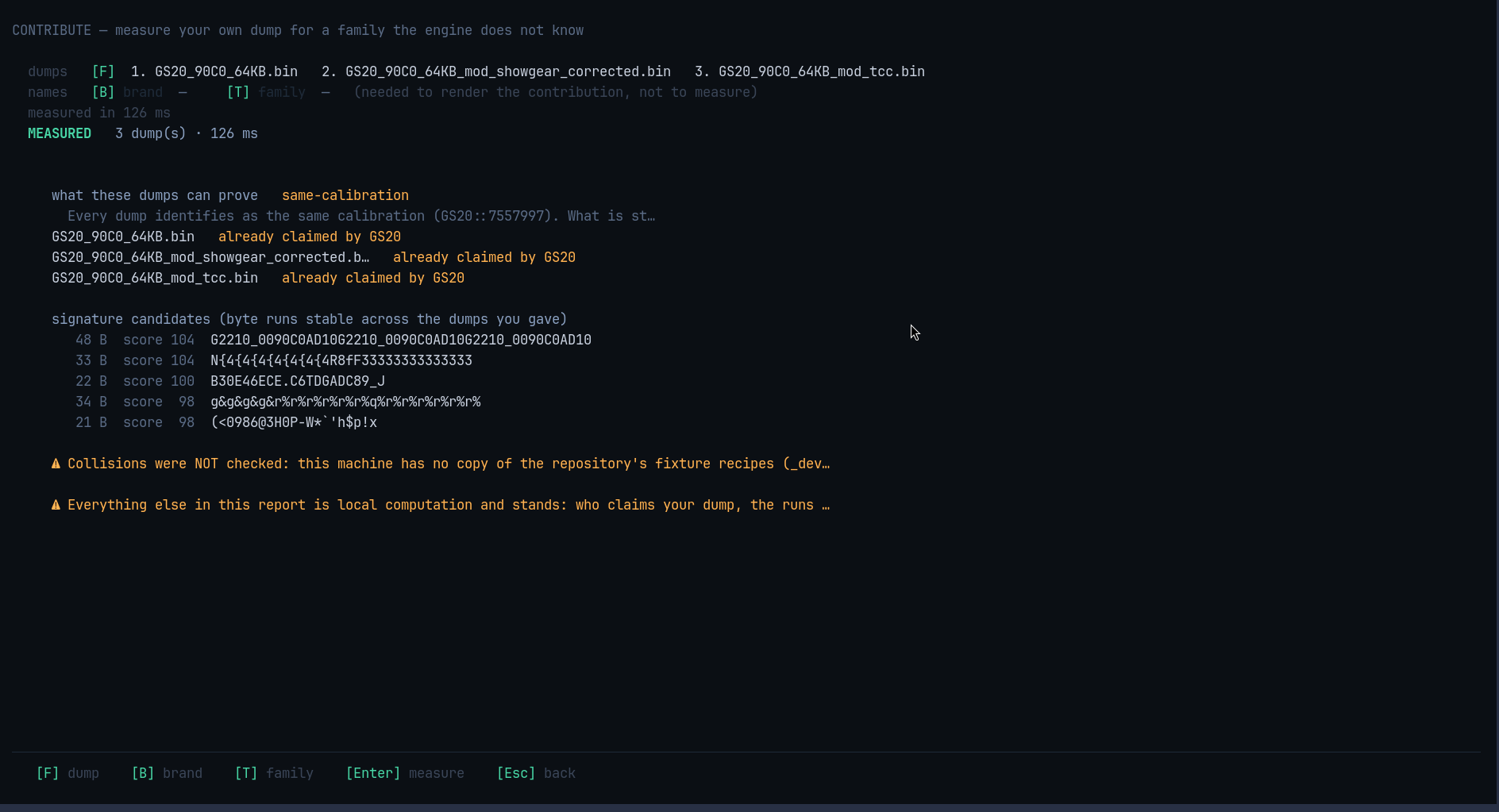
The promise, on screen
Your dumps never leave this machine. What a contribution commits is a synthetic fixture carrying only the marker, an extractor skeleton, a test and a report — never your binary.
What you see after pressing Enter
| Line | Meaning |
|---|---|
MEASURED 3 dump(s) · 126 ms |
how many files it read, and how fast |
what these dumps can prove |
whether your files can even support a contribution |
already claimed by GS20 |
someone else's code already recognises these files |
signature candidates |
byte patterns that are identical in all your files, with a score |
⚠ Collisions were NOT checked |
the honesty line — it could not test against other families |
That second line matters. Files of the same calibration can never prove a pattern is family-wide, so the tool tells you which case you are in before showing any candidates.
Two steps
| Step | Key | What happens |
|---|---|---|
| measure | Enter |
pure calculation on your files. Nothing is written, nothing is checked against other families |
| prepare | P |
needs a brand and a family; runs the collision check, renders the extractor, test, report and fixture, and runs the review bar over them |
Until P has run, "no collisions" has not been tested — and the screen says exactly
that instead of implying the pattern is safe.
Keys
| Key | What it does |
|---|---|
F |
add files (two or more, ideally different calibrations) |
B |
set the brand name |
T |
set the family name |
Enter |
measure |
P |
prepare the contribution |
W |
write the files out |
Esc |
back to HOME |
The same thing from the command line is
openremap contribute.